
The ROE Illusion: Why California’s SB 905 Won’t Slash Utility Profits Overnight

Governor Gavin Newsom signed Senate Bill 905 into law on September 30, 2026, amid intense public frustration over soaring electricity bills. Over the past decade, average residential electric rates charged by California’s three major investor-owned utilities - Pacific Gas & Electric (PG&E), Southern California Edison (SCE), and San Diego Gas & Electric (SDG&E) - have climbed to roughly twice the national average. When the Legislature passed SB 905 alongside its sister bill SB 913, news headlines and advocacy announcements celebrated the package as a sweeping victory that would immediately curb utility spending and slash corporate profits.
However, hold your horses - a rigorous audit of the statutory text, legislative history, and California Public Utilities Commission (CPUC) ratemaking mechanics reveals a far more modest reality.
SB 905 does not impose immediate caps on utility profits, nor does it penalize executive bonuses. Instead, key legislative amendments transformed what began as mandatory statutory cuts into discretionary regulatory considerations. To understand SB 905's true effect, we must look at how California regulates utility rates and why statutory discretion leaves the baseline profit model untouched.
This article is Part 1 of a three-part investigative series examining California's electricity affordability crisis:
Part 1 (This Piece): Debunks the political myth of SB 905, showing why targeting Return on Equity (ROE) cannot slash utility profits or monthly bills overnight.
Part 2: Unpacking the 90%: Why Your Electric Bill Explodes Even When Utility Profits Don't. A forensic breakdown of the true cost drivers - massive capital depreciation, billions in wildfire mitigation, and the rooftop solar "death spiral."
Part 3: Escaping the Abyss: Rate Redesign, the AI Load Surge, and California’s Clean Grid Endgame. An exploration of whether surging load growth and structural regulatory overhauls can pull California out of its affordability crisis.

Public commentary surrounding SB 905 focused heavily on its promise to hold electric utilities accountable for rising customer costs. As regulated monopolies, investor-owned utilities face no market competitors. As originally introduced by State Senator Josh Becker, the bill contained aggressive provisions designed to realign utility financial incentives directly with customer affordability.
The early version of the legislation included a proposed Public Utilities Code Section 399.10. That provision would have established a comprehensive CPUC performance metrics framework covering reliability, wildfire prevention, greenhouse gas emissions, and energization speed. Crucially, it would have mandated that large utilities tie at least 20 percent of executive compensation to keeping average electricity price increases below the federal cost of living adjustment (COLA).
However, during committee negotiations, legislative amendments dismantled these enforcement mechanisms.

On August 13, 2026, the Assembly Committee on Appropriations deleted proposed Section 399.10 in its entirety. The final statute signed by Governor Newsom contains no executive compensation penalties and no statutory performance metric mandates.
A similar softening occurred in the bill’s profit control section. Earlier drafts mandated that the CPUC assign a reduced Return on Equity (ROE) to specific capital expenditure categories. During a June 10, 2026 hearing, the Assembly Committee on Utilities and Energy flagged significant legal and regulatory concerns with that approach. Committee analyses noted that imposing rigid statutory ROE cuts without a regulatory safety valve threatened the CPUC’s constitutional authority to set "just and reasonable" rates, inviting protracted court challenges from utilities.
To protect regulatory flexibility, the committee amended Section 1 of the bill, codified as Public Utilities Code Section 451.11. The enacted text changes "shall assign a reduced ROE" to "shall consider assigning a reduced ROE." The law explicitly authorizes the CPUC to decline applying a lower ROE if commissioners find in writing that a reduction would not produce just and reasonable rates.

To understand the implications of utility profit control, one must examine how California regulates utility finances.
Electrical corporations like PG&E, SCE, and SDG&E operate under cost-of-service ratemaking. Regulated utilities do not make a profit markup on the electricity they deliver; fuel and purchased power are passed through dollar-for-dollar without profit. Instead, utilities earn shareholder returns exclusively on the physical capital assets they build - poles, wires, substations, and transformers - collectively known as the Rate Base.
Every three years, the CPUC conducts Cost of Capital proceedings. In these dockets, regulators establish the authorized capital structure (the blend of long-term debt, preferred stock, and common shareholder equity) and set the authorized Return on Equity (ROE), representing the percentage profit shareholders are permitted to earn on the equity-funded portion of the rate base:

Public Utilities Code Section 451.11 targets three specific categories of rate base capital for potential ROE reductions:
Capital costs recovered through balancing accounts or memorandum accounts.
Capital costs exempted by statute or regulatory order from a traditional reasonableness review.
Capital expenditures associated with electrical system undergrounding.
The economic logic behind is pretty straightforward: utilities should earn lower returns on low-risk projects. When a utility recovers costs through a balancing account, ratepayers insulate the company from forecast errors, substantially lowering financial risk for shareholders. Similarly, undergrounding lines carries minimal technological or cost recovery risk compared to complex transmission builds.
However, attempting to slice authorized ROE asset by asset creates administrative and financial complications. As committee experts observed, authorized ROEs are established in open, enterprise-wide Cost of Capital proceedings that already factor in utility risk profiles. Imposing a separate haircut on specific accounts risks double counting risk reductions already accounted for in the overall ~10 percent ROE.
Furthermore, if credit rating agencies perceive that asset-specific cuts depress earnings below market expectations, the utility's credit rating could suffer, driving up borrowing costs for long-term debt. Because ratepayers fund 100 percent of utility debt interest, higher borrowing costs could offset the very ratepayer savings Section 451.11 seeks to achieve.
More critically, the basic arithmetic of rate base returns demonstrates why targeted ROE reductions yield negligible bill impacts unless overall capital spending is constrained:

While $2.5 million sounds substantial, it represents less than 0.02% of a major California utility's multi-billion-dollar annual revenue requirement, amounting to pennies per month for individual households.
Because utilities earn profits on capital investments, they have an inherent incentive to inflate physical capital spending rather than optimize existing infrastructure. Trimming the profit percentage on a single subaccount alters annual revenues only at the extreme margin. Meaningful electricity rate relief requires constraining the total volume of capital added to the rate base in the first place.

While headline writers focused on ROE provisions, Sections 2 and 3 of SB 905 establish mechanisms intended to exert downward pressure on long-term capital additions.

Section 3 of the bill, codified as Public Utilities Code Section 769.1, introduces a "verification before construction" standard. Large electrical corporations must publish detailed grid data quantifying distribution capacity utilization, peak load, off-peak hosting capacity, and constrained circuit locations.
Because many circuits operate at peak capacity for only dozens of hours each year during heat waves, Section 769.1 obligates utilities to evaluate whether customer demand flexibility, home batteries, and distributed storage can meet local grid needs at a lower cost before proposing physical line expansions.
Section 2 of the bill directs the CPUC to open a formal rulemaking evaluating alternative financing structures, such as state-backed debt and securitization bonds. Electrical corporations must submit annual evaluations identifying low-cost debt opportunities, with a final CPUC report due to the Legislature by December 31, 2028.
While valuable, these mechanisms are not panaceas:
Non-wires alternatives (NWAs) like virtual power plants (VPPs) excel at shaving localized peak demand, but software cannot replace physical power line undergrounding or pole replacements in high fire-threat districts.
Replacing expensive equity with debt lowers costs initially, but excessive debt degrades utility balance sheets. Furthermore, ratepayer-backed bonds create non-bypassable fixed surcharges that linger on customer bills for 20 to 30 years, locking in long-term cost floors.
Sections 2 and 3 provide procedural transparency, but they cannot magically dissolve the tens of billions of dollars in hardened infrastructure California must deploy.

Despite the softening of SB 905 in legislative committees, consumer advocacy organizations like The Utility Reform Network (TURN) and Deploy Action supported the final bill. Their endorsement speaks to the fact that the discretionary language does not render the law toothless.
Section 451.11 indeed establishes a vital procedural paper trail. While the CPUC retains discretion to decline applying a reduced ROE, it cannot do so silently. The statute explicitly mandates that if commissioners decide against lowering authorized returns on balancing accounts or undergrounding projects, they must issue a formal written finding explaining why a reduced ROE would fail to produce just and reasonable rates.
This evidentiary leverage is essential given the trajectory of utility spending requests. The Public Advocates Office at the CPUC has warned that pending cost recovery applications from PG&E alone could drive electric rates up substantially by 2030 if approved without rigorous regulatory disallowances.
What Lies Ahead
The passage of SB 905 marks the end of legislative debate and the beginning of a technical regulatory implementation phase:
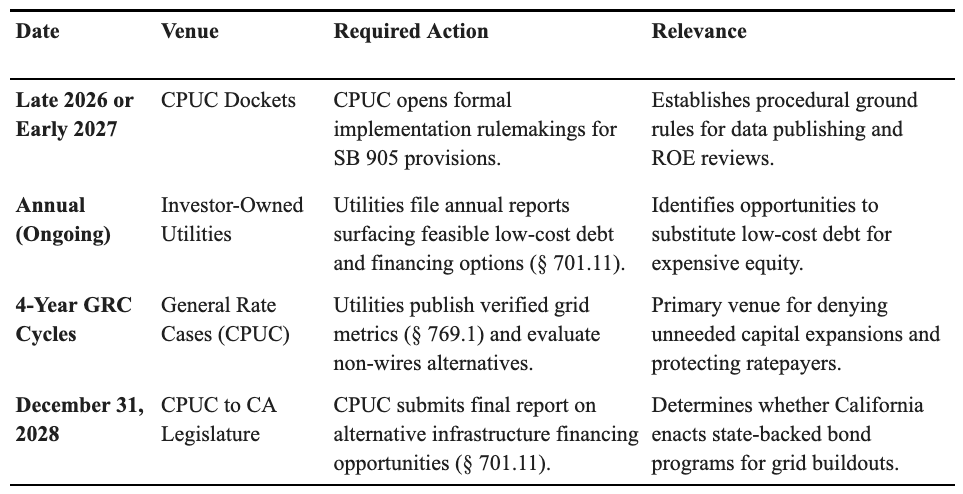
SB 905 will not slash utility profits overnight. It does not mandate immediate rate cuts, nor does it automatically cap corporate earnings. What it accomplishes is that it alters the regulatory rules of engagement. By pulling back the curtain on grid utilization data, mandating studies on cheaper debt financing, and forcing regulators to justify every dollar of profit granted on low-risk capital, SB 905 gives California administrative levers to rein in capital spending over time.
Yet, focusing entirely on corporate profit margins misses the true elephant in the room.
In California, shareholder profit accounts for a low double-digit percentage of a customer’s total monthly electricity bill. Even if SB 905 dropped authorized utility profits to absolute zero tomorrow, the majority of your electricity bill would remain untouched.
What is driving the other 80-90%? Why has California's average electricity price surged while inflation-adjusted prices across the rest of the country have remained flat? And why we suggest that you don't blame it all on AI and data centers.
In Part 2 of this series, Unpacking the 90%: Why Your Electric Bill Explodes Even When Utility Profits Don't, we perform an audit on the rest of California's rate stack and reveal to you how billions in wildfire mitigation, capital depreciation, and a rooftop solar driven "death spiral" are the true forces behind the scene.
References
Assembly Committee on Utilities and Energy. (2026, June 10). SB 905 (Becker) Committee Hearing Analysis (Analysis on Senate Bill 905 as amended June 1, 2026). California State Assembly.
Becker, J. (2026, May 28). Becker bill to lower electricity costs passes Senate floor [Press release]. Office of Senator Josh Becker.
Bonner, A. (2026, August 18). California advances two bills to expand virtual power plants, reduce energy rates.
California Independent System Operator, & Leap. (2025, February). The road to seven gigawatts: Concrete steps to unlock California’s demand response potential [Regulatory white paper]. California Independent System Operator.
California Public Utilities Commission. (2024). 2024 Senate Bill 695 Report: Report to the Governor and Legislature on Actions to Limit Utility Cost and Rate Increases Pursuant to Public Utilities Code Section 913. CPUC.
Deploy Action. (2026, August 24). Policy brief: SB 905 advances out of Assembly Appropriations. Deploy Action Newsroom.
Edison Electric Institute (EEI). (2024). Delivering America’s Energy Future: Electric Utility Capital Expenditures and Transmission/Distribution Modernization. EEI.
Lawrence Berkeley National Laboratory & The Brattle Group. (2025, October). Factors Influencing Recent Trends in Retail Electricity Prices in the United States: What do we know? Where are the gaps? (Presentation & Report LBNL-DOE).
The Public Advocates Office. (2025). Q1 2025 Electric Rates Report. California Public Utilities Commission.
U.S. Department of Energy (DOE). (2023, October). Pathways to Commercial Liftoff: Virtual Power Plants. Loan Programs Office & Office of Technology Transitions.
Wiser, R., O'Shaughnessy, E., Barbose, G., Cappers, P., & Gorman, W. (2025). Factors influencing recent trends in retail electricity prices in the United States. The Electricity Journal, 38(107516), 1–10.
Comments